Go back
Fixing a data-accuracy problem in a core workflow
Led the redesign of critical review workflows and transaction experiences for a high-volume fintech platform. Simplified multi-step processes, reduced input friction, and improved data accuracy for financial professionals managing complex investment portfolios.
Role
Sole product designer
Platform
Web Application
Year
2022 - Present
Tags
Fintech
Systems Design
Data Visualization
Enterprise UX

In January 2022, I joined a financial platform project as the sole product designer.
I worked closely with the Product Owners (POs) and Product Manager (PM) to continuously improve the user experience and streamline the process of performing investment portfolio analysis. Through multiple design iterations and feature additions, we aimed to enhance the platform's usability and functionality for financial professionals.
Project brief
Recently our team has noticed several price errors (I will call them miscalculations) in our trade data, leading to incorrect pricing and inaccurate financial earnings assumptions. These errors have become a pressing issue as they impact the reliability of our product and ultimately the satisfaction of our customers.
So, on the next product meeting we raised the question:

Discovery
The current user flow allows for the resolution of miscalculations by taking action on the trade price. The price basically can be managed by the user when needed, but the miscalculations still exist in the application. This realization prompted us to explore the matter further during the product meeting.
In the initial phase, it was crucial to generate a list of quantitative data elements that can potentially affect the trade price, considering the feasibility of manipulating each item's value. During constructive discussions, it emerged that a significant majority of these elements were categorized as either fixed numbers or subject to external market regulations.
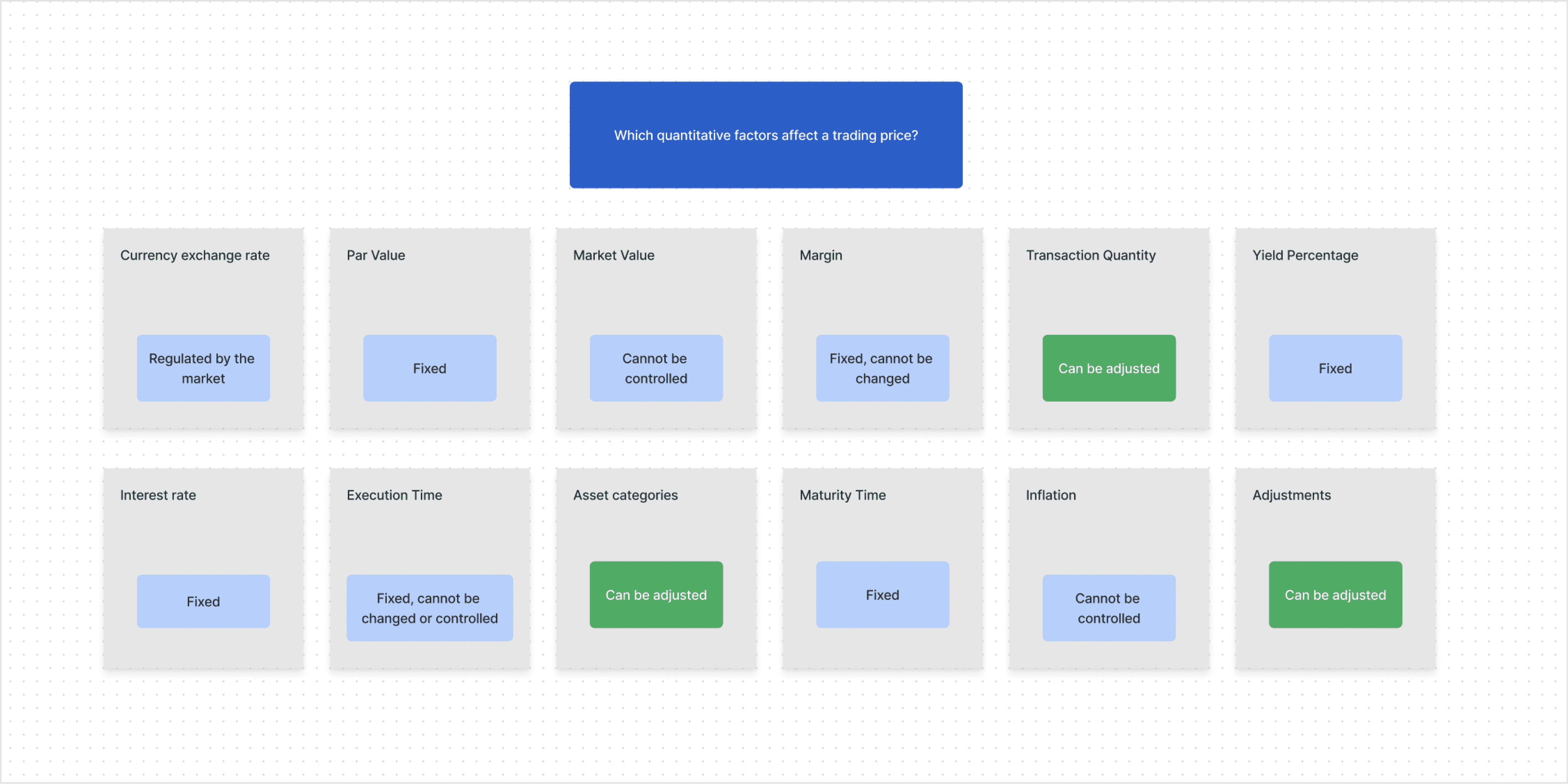
After brainstorming around the remaining items we came up with the 1 hypothesis:
Our financial professionals value our product, because it provides them with a detailed overview of the asset categories prices that directly impact the trade price, allowing our users to make better-informed decisions.
This became the starting point for the next step – user interviews.
Interviewing Users
Following the discovery workshop, I proceeded to conducted a series of interviews via Zoom. Considering that the feature impacted the workflows of 90% of our users, it was essential to ensure representation from both user categories.
The participant sample included 5 individuals from each category: financial advisors (manage the entire firm) and traders (actively engaged in the trading process).
Gathering insights
After the interviews, the key pain points and action observations of financial advisors and traders were identified. We also successfully confirmed the active use of asset categories in day-to-day operations related to trade prices.

The insights have provided an idea for potential changes in the user flow, as depicted below. We will further develop this concept moving forward.

Storyboards
Drawing upon our observations and careful analysis of user interactions, we have crafted a storyboard that illustrates the steps by which users navigate and resolve the price miscalculation plaguing their trading experience.
This illustrated storyboard serves as a valuable tool that allows us to identify the main cause of the issues and serves as a starting point for reimagining the flow and making necessary changes.
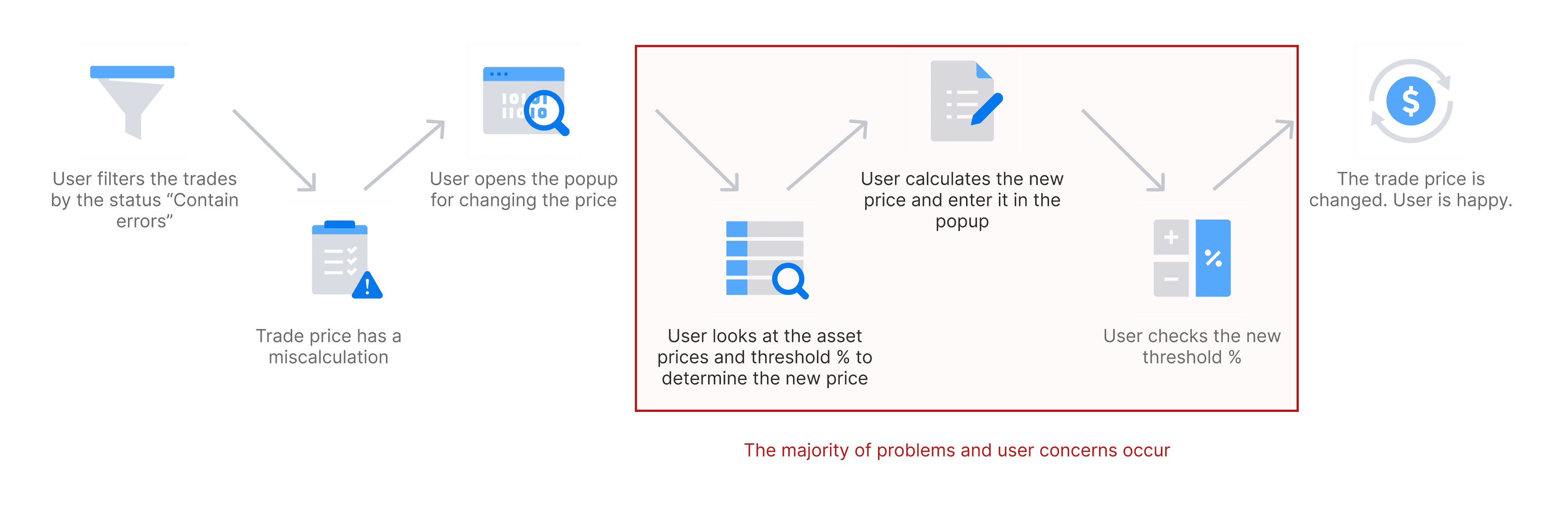
We thought about how we could incorporate the desired change into the process involving asset categories prices. Consequently, we streamlined the problematic sequence into a more efficient flow reducing the steps by 35%.

Brainstorming
Implementing Jobs to be Done approach to my process helps me with better understanding the practical value the solution might bring to the users.

Features shipped
Subsequently, I began to braistorm to explore potential features (using Crazy 8's) and build user flows to assess the areas that will be impacted by the new solution.
After working on dozens of wireframes, we finally arrived at several decisions to ensure the effectiveness of user work:
Assets categories grid with statuses
The status indicators enable users to quickly identify trades with miscalculations. Moreover, the user can easily sort or filter by statuses to focus only on critical trades that require recalculation.
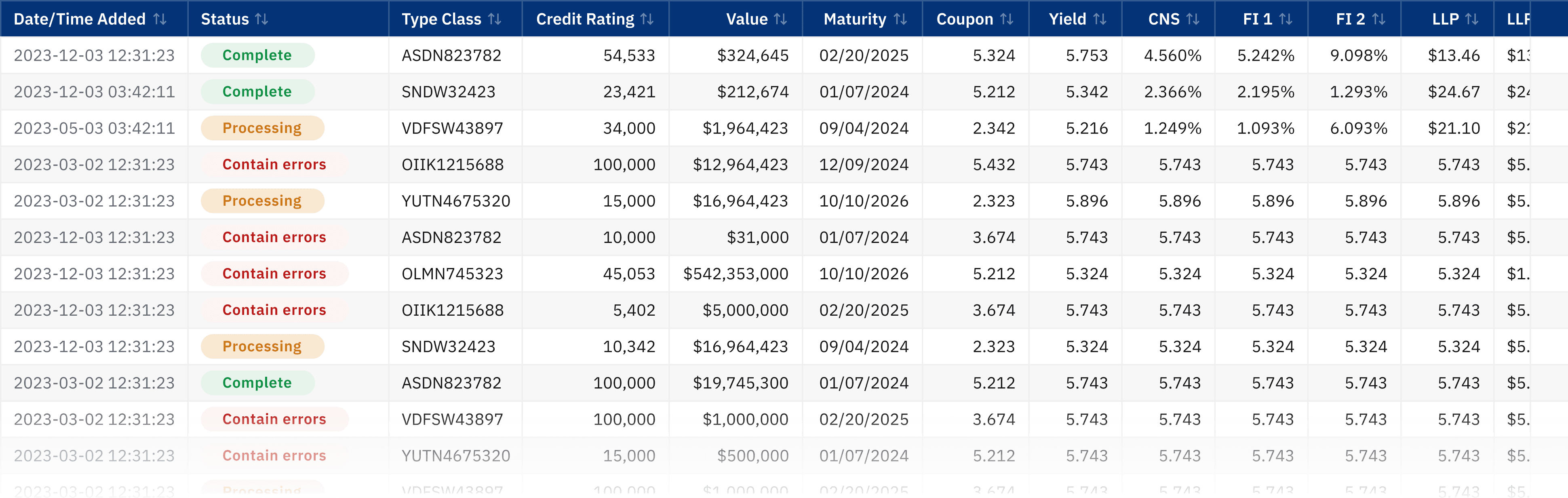
When exploring the feature within its context, the asset categories table grid will be positioned below its distribution. This placement will provide traders with valuable insights regarding potential miscalculations, guiding them to examine the corresponding trades in more detail.

Automated calculation prices
By clicking on the "Take Action" button, users will be prompted with a modal that grants them complete access to modify prices.
When they input a new price, the trade price will undergo an automatic recalculation process, ensuring that they receive more precise and up-to-date information in a timely manner. Users are also informed about impact of the threshold percentage (that is color coded) to assess the favorability of the price.

Miscalculations Handling on the individual level and grouped
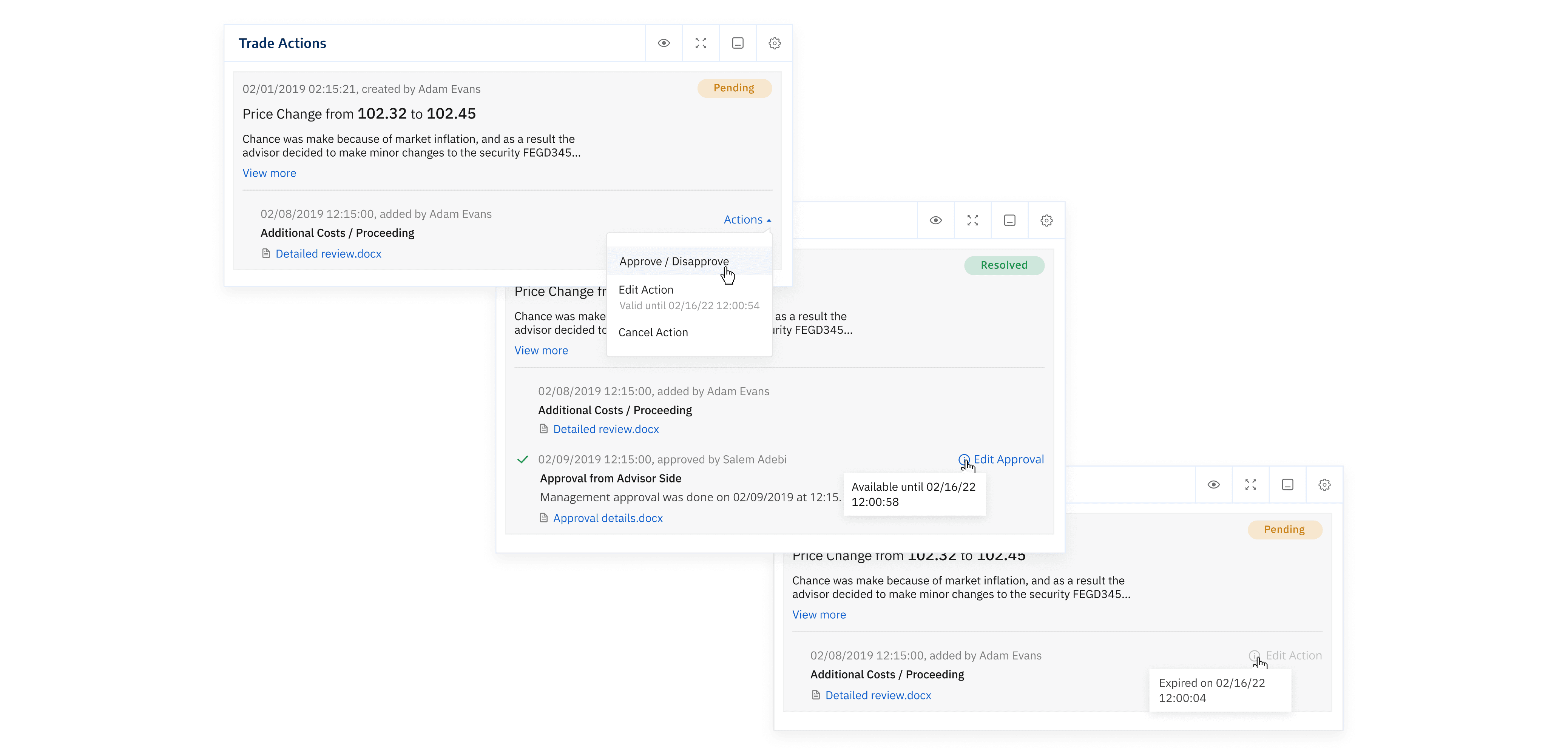
Allowing users to handle trade miscalculations in groups and facilitates quicker resolution of miscalculations for multiple trades simultaneously.
The modified asset categories will only apply to trades with miscalculations, further streamlining the process.
Impact
We kept close communication with our users for a couple of months after the release, actively listening to their feedback and observing their actions. As a result, we were able to achieve the following:

Conclusion
This project gave me an exponential growth and I am very proud to see the changes that help users minimise their financial risks on providing them with better analyzing tools and a variety of precise data.
I am also very grateful for the whole team that helps me push my boundaries and constantly challenges me to make better design choices; they are the sweetest people I know :)
Back to Top